Useful Digression LLC
Minneapolis, Minn.
Jargon pressure
4 psi
Technical Bulletin No. 001 Form UD-1 · Series A · First Edition Supersedes: nothing

Principles of operation, installation & routine maintenance

The Useful Digression
Apparatus

Model 1-A. For the orderly conversion of things that were not on the agenda into things that are of some use.

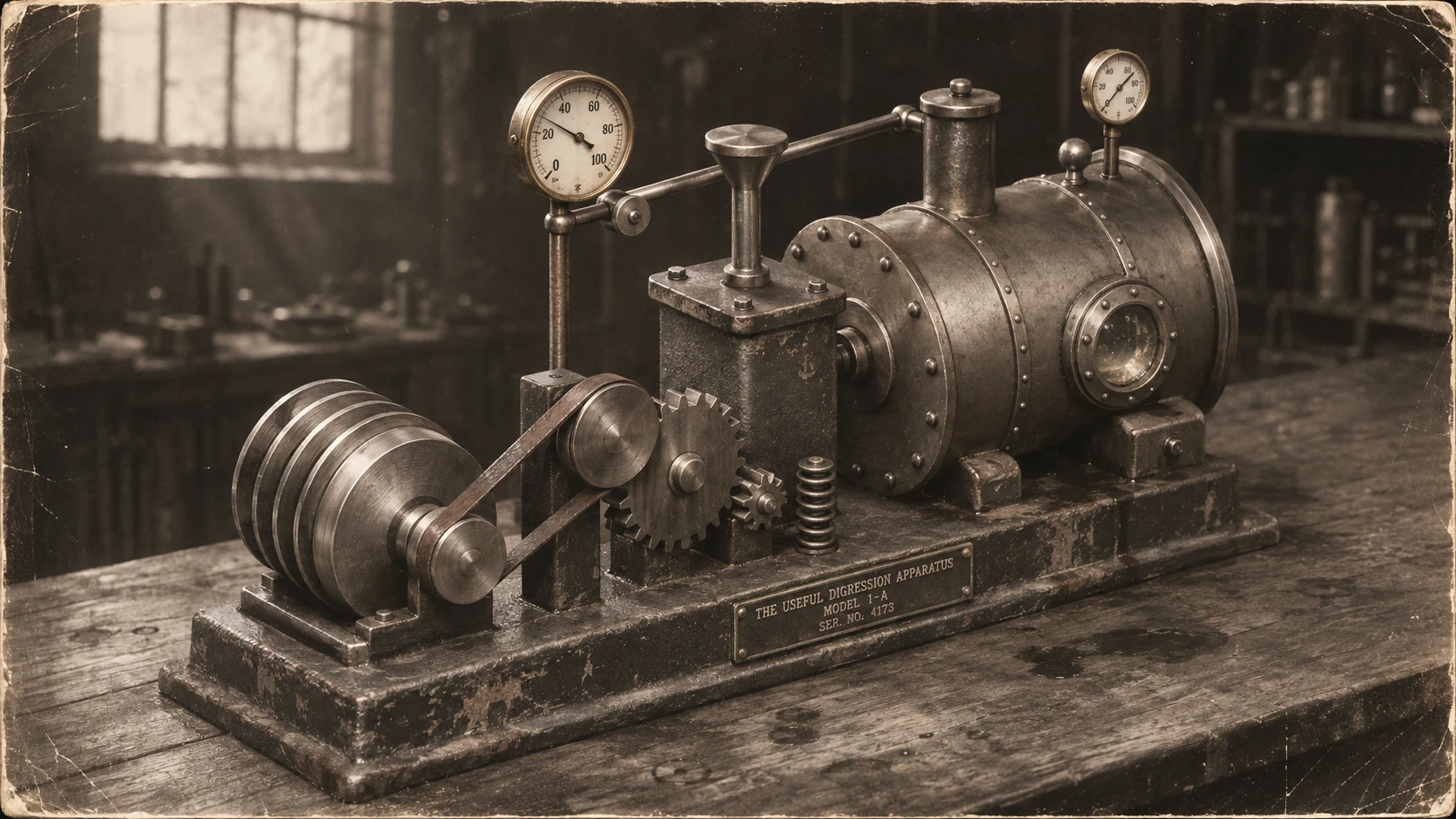
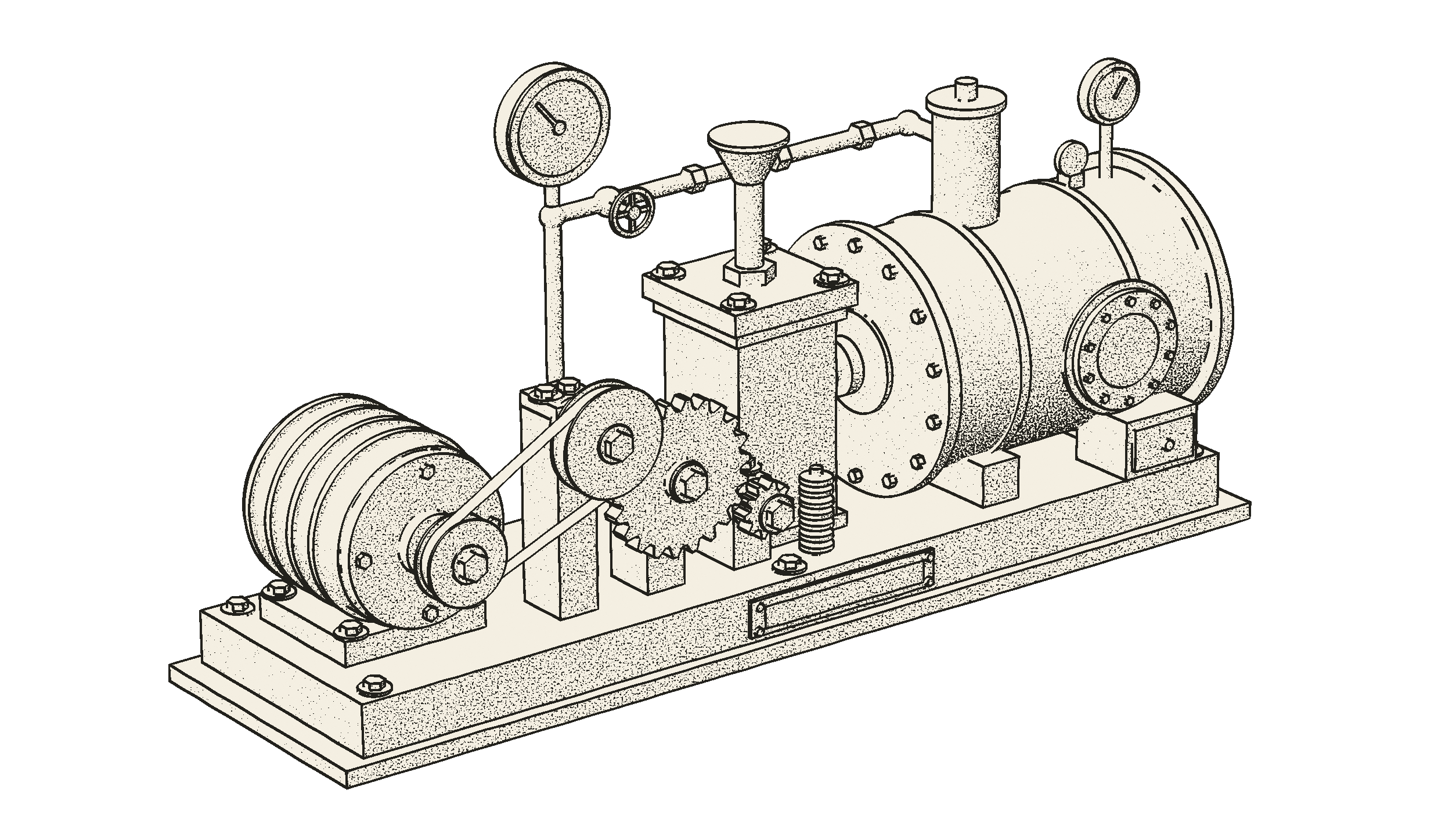
Archival-style photograph of the apparatus on a workbench: a belt-driven motor, a gear train, two pressure gauges, a hopper, and a riveted drum with an inspection port. A nameplate reads The Useful Digression Apparatus, Model 1-A, Ser. No. 4173. 13 7 1 4 6 5 9 12 8 10 2·3 11
Experimental assembly
Do not straighten
Plate I. The apparatus, Model 1-A, Ser. No. 4173, as commissioned. Photographic evidence. Nothing has been touched.

Operators should read this bulletin in its entirety before attempting to stop reading it. ↓

§1 · Introduction Technical density: Grade A

Purpose of the apparatus

Since the spring of 2026, the workshop has been engaged in the development of an apparatus capable of receiving an idea of no particular importance and returning, after due processing, a piece of software of some use.

The present bulletin describes that apparatus.

“There must be a less annoying way to do this.”

Hopper ready. Awaiting a suitably minor inconvenience.

§2 · Principle of operation Technical density: Grade B

The deferred-relevance cycle

In its basic form the apparatus consists of an intake hopper, a lateral drive, and an output drawer of deliberately inadequate size. The incoming thought is first passed through a tangential impeller, which separates the interesting problem from the needlessly interesting solution and discharges the latter through a side port.

The remainder is conducted by way of a semi-deliberate reluctance coupling to the primary reconsideration drum, where it is held at constant doubt until every practical application has been formally ruled out. Only then is it released, under governor control, to the lateral drive.

Where a thought arrives exhibiting excessive usefulness, the governor will introduce a secondary tangent automatically, so that the operator need never proceed directly to the point. This arrangement, known in the trade as the deferred-relevance cycle, is responsible for the characteristic hum.

Owing to the opposed pitch of the left- and right-hand impellers, the net lateral displacement of any given idea is zero, although the idea will be found to have moved.

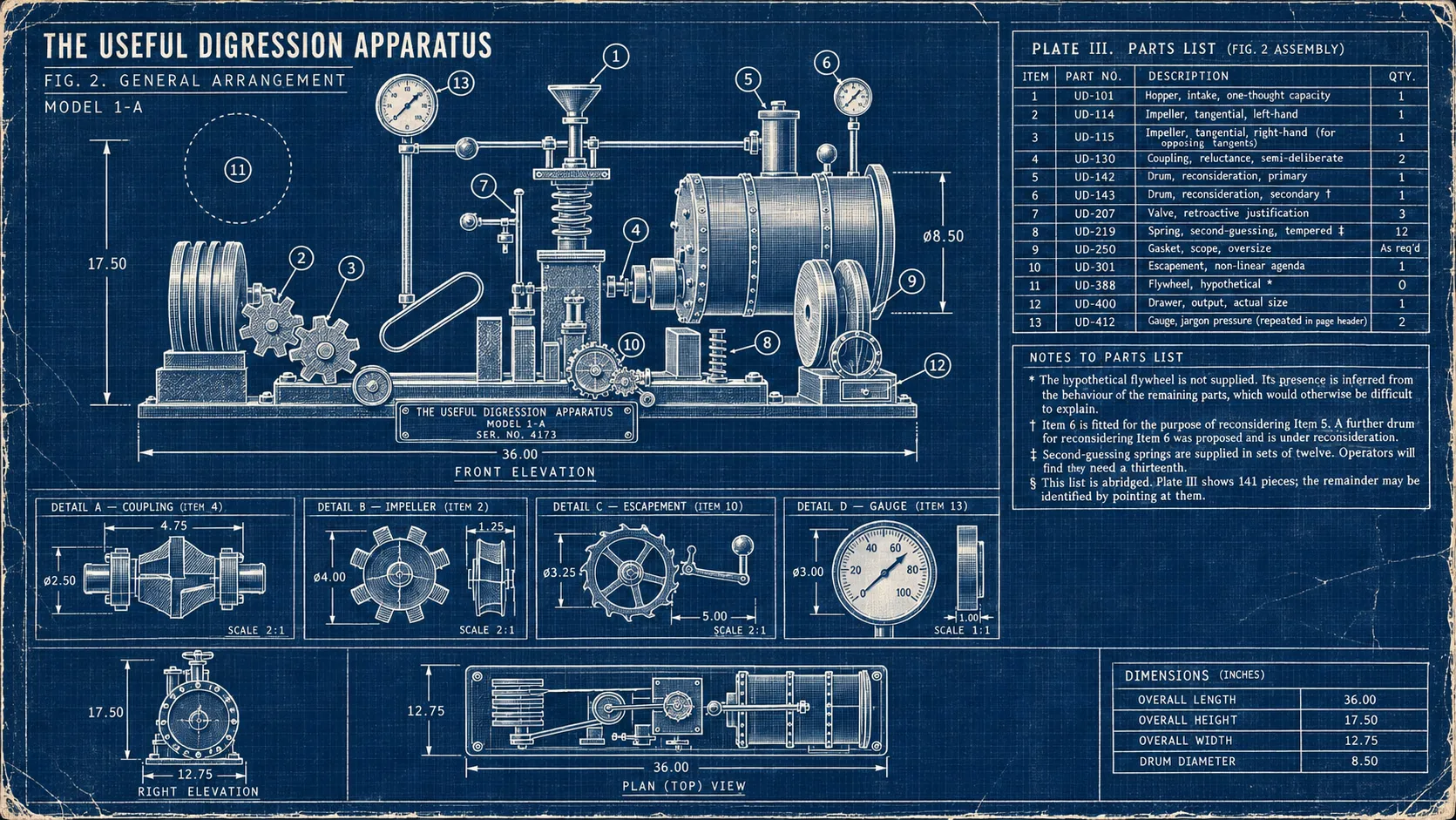
Blueprint of the apparatus, Model 1-A: a front elevation with thirteen numbered parts, the hypothetical flywheel shown as an empty dashed circle; smaller right elevation and plan views; four detail drawings; the parts list and its notes as given in section 3; and overall dimensions of 36 by 17.5 by 12.75 inches.
Fig. 2. General arrangement, from the works blueprint. Dimensions in inches, where given. Drawing is explanatory, not helpful.
§3 · Principal components Technical density: Grade C

Exploded view & parts list

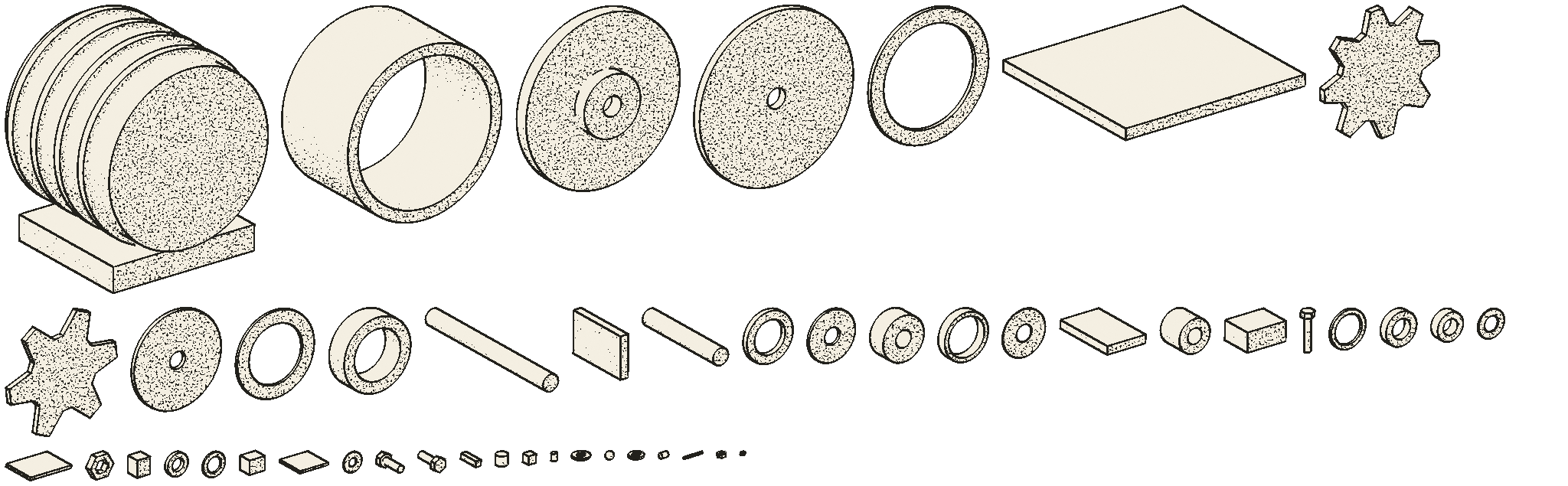
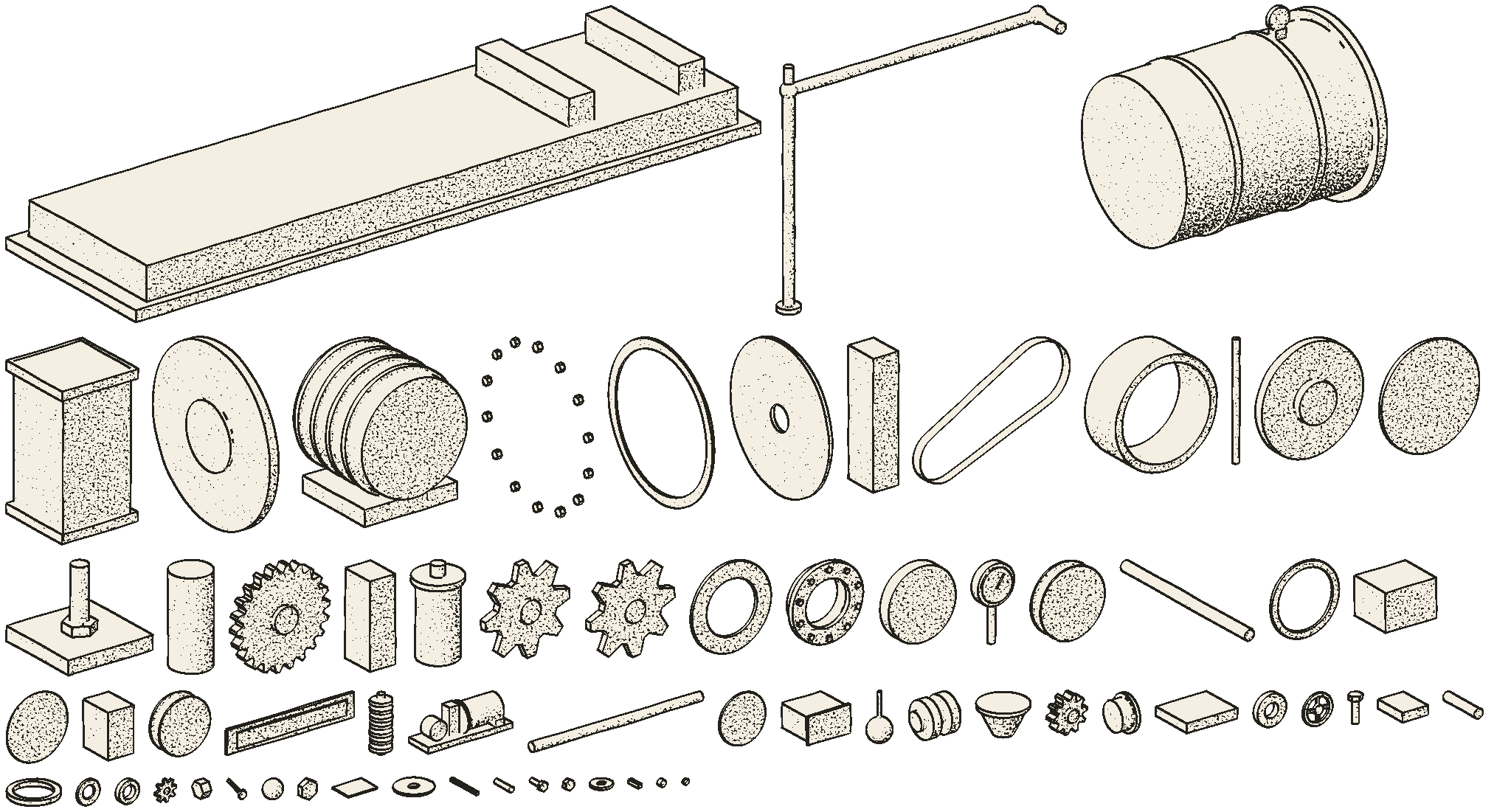
The following plate shows the apparatus, which the reader will now take apart by continuing to read. Parts are shown in order of removal. Parts not shown are shown elsewhere, or are not parts.

Point at any of the 141 pieces to identify it.
Plate III. The apparatus in 141 pieces: first by assembly, then further than was asked. Reassembly is the reverse of this procedure, approximately.
Item Part no. Description Qty
1 UD-101 Hopper, intake, one-thought capacity 1
2 UD-114 Impeller, tangential, left-hand 1
3 UD-115 Impeller, tangential, right-hand (for opposing tangents) 1
4 UD-130 Coupling, reluctance, semi-deliberate 2
5 UD-142 Drum, reconsideration, primary 1
6 UD-143 Drum, reconsideration, secondary † 1
7 UD-207 Valve, retroactive justification 3
8 UD-219 Spring, second-guessing, tempered ‡ 12
9 UD-250 Gasket, scope, oversize As req’d
10 UD-301 Escapement, non-linear agenda 1
11 UD-388 Flywheel, hypothetical * 0
12 UD-400 Drawer, output, actual size 1
13 UD-412 Gauge, jargon pressure (repeated in page header) 2

Notes to parts list

* The hypothetical flywheel is not supplied. Its presence is inferred from the behaviour of the remaining parts, which would otherwise be difficult to explain.

† Item 6 is fitted for the purpose of reconsidering Item 5. A further drum for reconsidering Item 6 was proposed and is under reconsideration.

‡ Second-guessing springs are supplied in sets of twelve. Operators will find they need a thirteenth.

§ This list is abridged. Plate III shows 141 pieces; the remainder may be identified by pointing at them.

§3.1 · Detail plates Technical density: Grade C, continued

The assemblies, individually

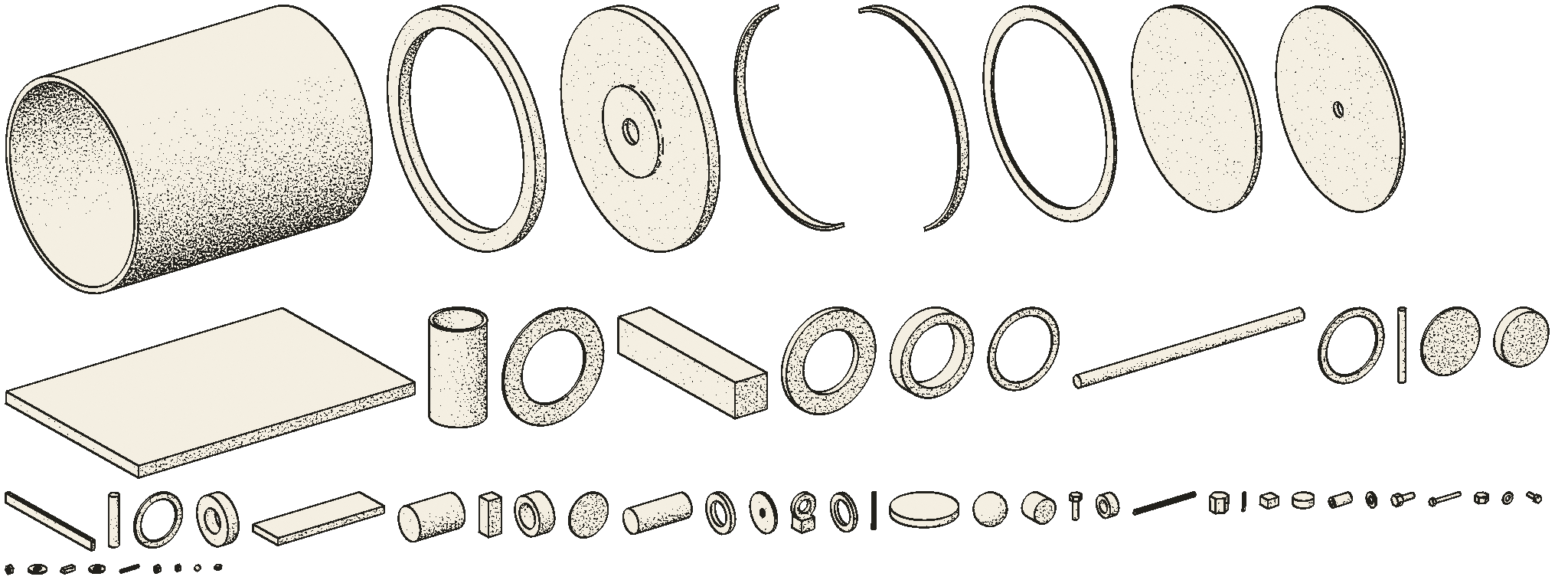
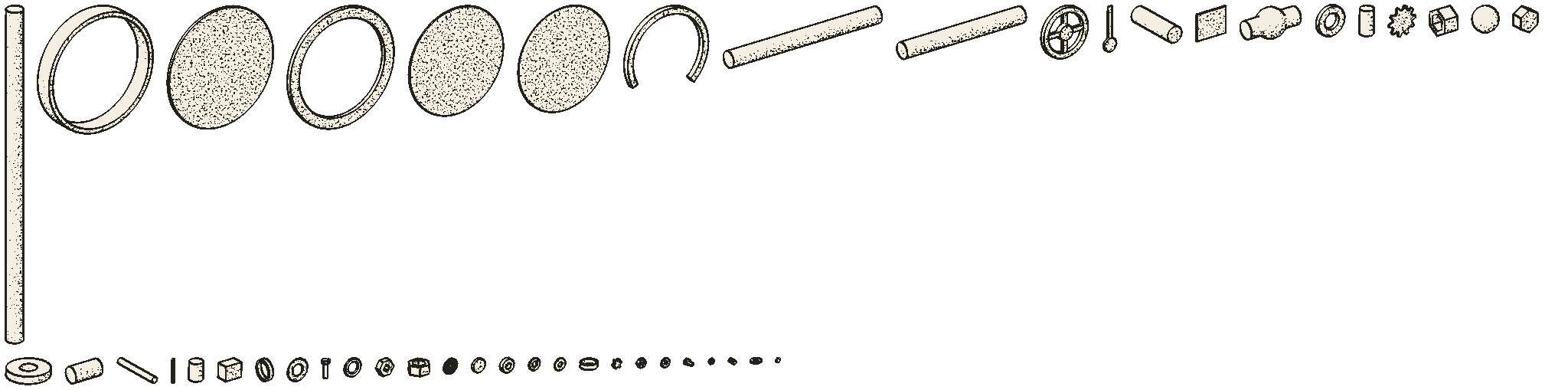
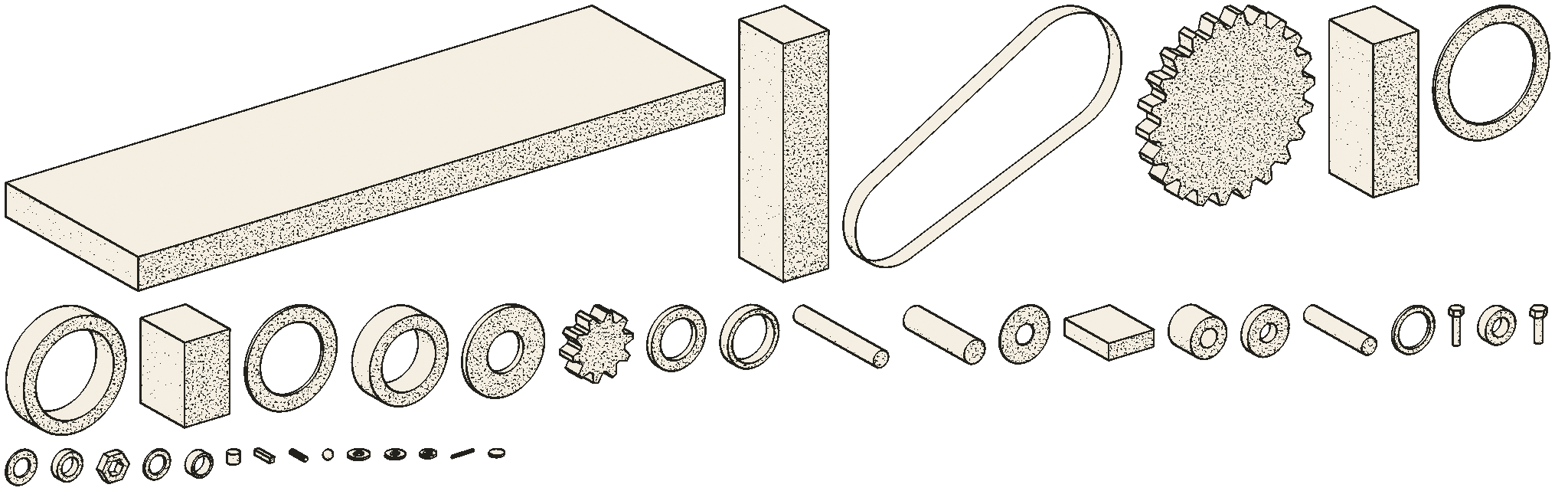
Plate III having established that the apparatus consists of parts, the following plates establish what the parts consist of. Each assembly is shown at a scale which permits the reader to lose sight of the apparatus altogether. 717 pieces are accounted for across Plate III and Details E to H; no piece has been counted twice on purpose. Details A to D will be found on Fig. 2, where they were put before these were thought of.

Point at any of the 167 pieces to identify it.
Detail E. The lateral drive, in 167 pieces. Three shafts, six bearings, forty-eight balls, and one belt joined to itself.
Point at any of the 120 pieces to identify it.
Detail F. The prime mover, in 120 pieces. The laminations may be replaced in any order. They will know.
Point at any of the 210 pieces to identify it.
Detail G. The primary reconsideration drum, in 210 pieces. Includes a smaller apparatus and, within that, the smallest.
Point at any of the 79 pieces to identify it.
Detail H. The instruments of observation, in 79 pieces. The glass is kept behind the dial, for safety.
§4 · Calibration of the auxiliary reconsideration chamber Technical density: Grade D

Inside the machine, a smaller machine

Before first use the apparatus must be brought into calibration. With the drawer closed and the hopper empty, advance the overthinking regulator to Setting II and observe the auxiliary reconsideration chamber.1

The chamber, which is itself a complete Model 1-A apparatus of reduced scale,2 should commence examining the main unit at a rate of not less than one doubt per revolution of the lateral drive. A faint ticking at this stage is normal and indicates that the escapement is releasing the agenda in the correct, non-linear order.

Should the chamber begin examining itself, the regulator has been advanced beyond Setting III.3 Return it to Setting II and allow the chamber to come to rest. Do not attempt to open the inner drawer.4

Where the output exhibits a usefulness in excess of that indicated on Fig. 7, the governor should be inspected for wear. A governor in good order will never permit more than one useful thing to leave the apparatus at a time.

⚠ Caution Do not attempt to simplify the apparatus while it is running. Simplification is performed by the apparatus.

1 See §3, Item 5.
2 The reduced-scale unit contains a further reduced-scale unit. The workshop has not yet established how far this continues. See note 2.
3 Settings IV and V are provided for completeness.
4 The inner drawer contains a smaller drawer.

The apparatus in its calibration chamber. Through the inspection port of its drum a smaller copy of the apparatus can be seen, and through that one's port, another.
Setting V

Setting V: All available machinery is now considering the drawer. Not recommended.

OPTIMUM (NOT LOCATED) IIIIIIIVV DEGREE OF RECONSIDERATION USEFULNESS
Fig. 7. Usefulness of output as a function of reconsideration. Plotted from observation; observation plotted from memory.
§5 · Fault diagnosis & remedy Technical density: Grade E

Troubleshooting

Faults are listed in order of discovery. Where more than one remedy applies, apply the remedy listed first, then reconsider. Faults not listed are to be regarded as features pending documentation (see §5.4(b)(ii), not yet written).

Enlarged detail of the photograph showing the housing of the apparatus’s small output drawer
REVISED
Plate IV. Item 12, enlarged 5×. Actual size: smaller.
Symptom Probable cause Remedy
Apparatus produces nothing. Hopper contains a fully formed business plan. Remove plan. Insert a minor inconvenience.
Apparatus produces something other than what was put in. Normal operation. None required.
Output drawer will not close. Output too large; scope gasket (Item 9) has failed. Remove features until the drawer closes. Replace gasket.
Persistent low hum. Deferred-relevance cycle. This is the apparatus working.
Operator reports that the idea was obvious. Retroactive justification valve (Item 7) seated incorrectly. Reseat valve. Re-read §2 until the idea is no longer obvious.
Ticking ceases; hum continues. Escapement (Item 10) is releasing the agenda in linear order. Disconnect agenda. Allow escapement to resume at its own discretion.
Apparatus has begun troubleshooting itself. Regulator advanced beyond Setting III. See §4. See also §4.
Operator is reading this table in full. Insufficient digression. Proceed directly to Appendix F.
Appendix F · Complete schedule of tolerances Technical density: Grade F

All dimensions in inches unless stated in doubts. Values marked † were obtained with the regulator at Setting V and should not be relied upon. Values not marked † should not be relied upon either.

Lateral drive, backlash nominal
Impeller, L.H., relevance drift 1⅜ doubts
Impeller, R.H., runout unchanged
Reluctance coupling, overtravel 3 doubts
Primary drum, free length not measured
Secondary drum, lash, reconsidered 0.040 †
Justification valve, doubt per rev. 0.0005
Second-guessing spring, end float 0.125
Scope gasket, dwell see §4
Agenda escapement, preload ±0.002
Hypothetical flywheel, lash, cold hypothetical
Output drawer, seat clearance to taste
Intake hopper, backlash 0.000
Governor, relevance drift ±0.010 †
Aux. chamber, runout ±0.001
Inner drawer, overtravel ±½ thought
Hum, free length nominal
Lateral drive, backlash 1⅜ doubts
Impeller, L.H., relevance drift unchanged
Impeller, R.H., runout 3 doubts
Reluctance coupling, overtravel not measured
Primary drum, free length 0.040 †
Secondary drum, lash, reconsidered 0.0005
Justification valve, doubt per rev. 0.125
Second-guessing spring, end float see §4
Scope gasket, dwell ±0.002
Agenda escapement, preload as observed
Hypothetical flywheel, lash, cold hypothetical
Output drawer, seat clearance 0.000
Intake hopper, backlash ±0.010 †
Governor, relevance drift ±0.001
Aux. chamber, runout ±½ thought
Inner drawer, overtravel nominal
Hum, free length audible
Lateral drive, backlash unchanged
Impeller, L.H., relevance drift 3 doubts
Impeller, R.H., runout not measured
Reluctance coupling, overtravel 0.040 †
Primary drum, free length 0.0005
Secondary drum, lash, reconsidered 0.125
Justification valve, doubt per rev. see §4
Second-guessing spring, end float ±0.002
Scope gasket, dwell as observed
Agenda escapement, preload to taste
Hypothetical flywheel, lash, cold hypothetical
Output drawer, seat clearance ±0.010 †
Intake hopper, backlash ±0.001
Governor, relevance drift ±½ thought
Aux. chamber, runout nominal
Inner drawer, overtravel 1⅜ doubts
Hum, free length unchanged
Lateral drive, backlash 3 doubts
Impeller, L.H., relevance drift not measured
Impeller, R.H., runout 0.040 †
Reluctance coupling, overtravel 0.0005
Primary drum, free length 0.125
Secondary drum, lash, reconsidered see §4
Justification valve, doubt per rev. ±0.002
Second-guessing spring, end float as observed
Scope gasket, dwell to taste
Agenda escapement, preload 0.000
Hypothetical flywheel, lash, cold hypothetical
Output drawer, seat clearance ±0.001
Intake hopper, backlash ±½ thought
Governor, relevance drift nominal
Aux. chamber, runout 1⅜ doubts
Inner drawer, overtravel unchanged
Hum, free length audible
Lateral drive, backlash not measured
Impeller, L.H., relevance drift 0.040 †
Impeller, R.H., runout 0.0005
Reluctance coupling, overtravel 0.125
Primary drum, free length see §4
Secondary drum, lash, reconsidered ±0.002
Justification valve, doubt per rev. as observed
Second-guessing spring, end float to taste
Scope gasket, dwell 0.000
Agenda escapement, preload ±0.010 †
Hypothetical flywheel, lash, cold hypothetical
Output drawer, seat clearance ±½ thought
Intake hopper, backlash nominal
Governor, relevance drift 1⅜ doubts
Aux. chamber, runout unchanged
Inner drawer, overtravel 3 doubts
Hum, free length not measured
Lateral drive, backlash 0.040 †
Impeller, L.H., relevance drift 0.0005
Impeller, R.H., runout 0.125
Reluctance coupling, overtravel see §4
Primary drum, free length ±0.002
Secondary drum, lash, reconsidered as observed
Justification valve, doubt per rev. to taste
Second-guessing spring, end float 0.000
Scope gasket, dwell ±0.010 †
Agenda escapement, preload ±0.001
Hypothetical flywheel, lash, cold hypothetical
Output drawer, seat clearance nominal
Intake hopper, backlash 1⅜ doubts
Governor, relevance drift unchanged
Aux. chamber, runout 3 doubts
Inner drawer, overtravel not measured
Hum, free length audible
Lateral drive, backlash 0.0005
Impeller, L.H., relevance drift 0.125
Impeller, R.H., runout see §4
Reluctance coupling, overtravel ±0.002
Primary drum, free length as observed
Secondary drum, lash, reconsidered to taste
Justification valve, doubt per rev. 0.000
Second-guessing spring, end float ±0.010 †
Scope gasket, dwell ±0.001
Agenda escapement, preload ±½ thought
Hypothetical flywheel, lash, cold hypothetical
Output drawer, seat clearance 1⅜ doubts
Intake hopper, backlash unchanged
Governor, relevance drift 3 doubts
Aux. chamber, runout not measured
Inner drawer, overtravel 0.040 †
Hum, free length 0.0005
Lateral drive, backlash 0.125
Impeller, L.H., relevance drift see §4
Impeller, R.H., runout ±0.002
Reluctance coupling, overtravel as observed
Primary drum, free length to taste
Secondary drum, lash, reconsidered 0.000
Justification valve, doubt per rev. ±0.010 †
Second-guessing spring, end float ±0.001
Scope gasket, dwell ±½ thought
Agenda escapement, preload nominal
Hypothetical flywheel, lash, cold hypothetical
— End of technical material —

§6 · Output

And after all that:

The drawer is deliberately smaller than the machine.

Fig. 12 · A surprisingly useful thing

First output currently under examination.

A piece of software is taking shape in the workshop. Its name and particulars will appear in this drawer when it is ready to leave the bench.

In development · Not yet released

A note about the manufacturer

A real company.
An imaginary machine.

Useful Digression LLC is an independent software company founded by Paul Brazelton in Minneapolis, Minnesota.

It is a home for apps, experiments and useful things that don’t necessarily belong in the same category. The machinery above is fiction. The intention to make thoughtful software is not.

No industrial equipment is required to use our work.

Correspondence & technical inquiries

paul@usefuldigression.com